“1491: New Revelations of the Americas Before Columbus” - Charles C. Mann
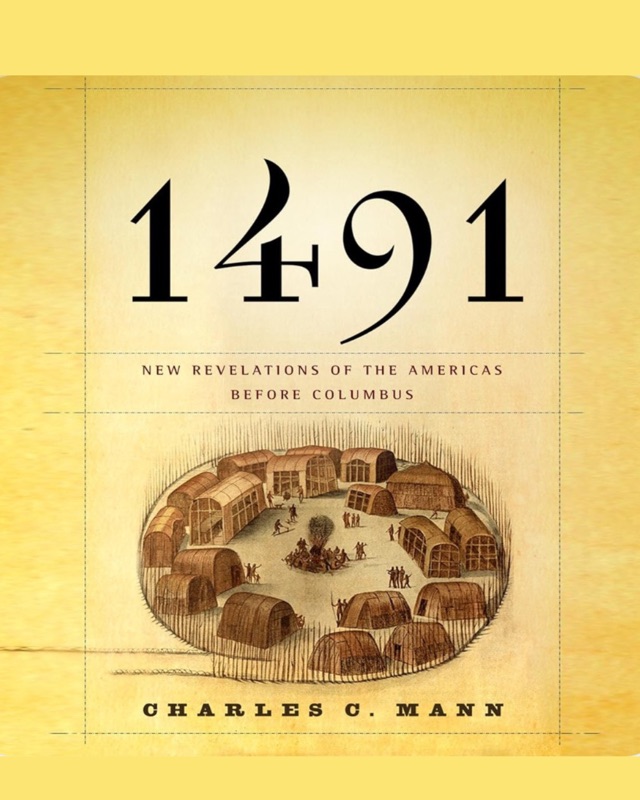
🗺️Brace yourselves, Mann is about to take you on a tour de force of Mesoamerican history. The journey will bounce around quite a bit from virology to genetics, linguistics to anthropology. Mann happily rambles non-linearly from the age of the conquistadors to the Pleistocene era, to the Wampanoag and Pilgrims. On the next page we’re in the heyday of the Inca Empire.
🗺️ I’ve never been exposed to such a wealth of knowledge about Mesoamerica. 1491doesn’t just add detail, it forces a total recalibration of what many of us were taught to believe about the Americas before Columbus.
🗺️ It is the kind of nonfiction that rearranges your entire understanding of “American history.” The most gripping (and devastating) takeaway: pre-Columbian Mesoamerica wasn’t sparse or “pristine”—it was densely populated, engineered, sophisticated, and profoundly historical—before disease and colonization erased millions and drastically rewrote the narrative. Most of us recognize that Indigenous civilizations got reduced to a footnote in school. This book demonstrates the magnitude of that omission.
🗺️ There are some nonfiction books that teach you new facts, and then there are nonfiction books that make you realize the entire framework you’ve been using is faulty. 1491 falls firmly into the latter category. The unsettling thing isn’t simply that we were missing details in traditional American history courses. Most of us recognized quite clearly that history did not simply begin with the arrival of Europeans in North America. But I, for one, was astonished by the scale and complexity of what the pre-Columbian Americas were as expounded by 1491.
🗺️ If your education looked anything like mine, everything before European arrival was treated as a vague prelude: scattered communities, isolated tribes, an untouched wilderness waiting for the first “real” chapter to begin. Not explicitly, perhaps—but unmistakably so. The Americas were often framed as pristine, empty, and static: a stage set for someone else’s history. But as critical thinkers, we knew that this could not be true if the land was already inhabited. Satisfyingly, 1491 demolishes that notion.
🗺️ We have all been taught some form of the “Pristine Myth” and the convenient fantasy of empty territory.
One of Mann’s most striking contributions is his dismantling of the pristine myth—the idea that the Americas consisted of vast, unspoiled lands before Europeans arrived. It’s a myth that shows up everywhere: in textbooks, in maps, in the way we talk about “wilderness,” and especially in the storytelling shorthand that quietly suggests that if land looks empty now, it must have always been that way.
Mann argues that this is not only inaccurate—it’s revealing. The “empty continent” narrative doesn’t just happen by accident. It is an extremely useful tool when you want to justify claiming land. Mann calls it the “eternal unhistoried state”.
The more 1491 digs into Mesoamerica, the harder it becomes to sustain that fantasy. Mann carefully dismantles the notion that indigenous peoples did not alter their environment. These societies weren’t living in an eternal, unchanging “before.” They had cities, agriculture, political conflict, trade networks, ecological knowledge, and histories as dynamic and contested as anything we associate with the word “civilization.”
What changes everything is Mann’s attention to a detail that traditional courses often mention only in passing, if they mention it at all: the population in Mesoamerica ahead of European arrival.
🗺️ Newer population estimates change the entire story we have been told.
Many of the older estimates for Indigenous population in the Americas before Columbus were surprisingly low—numbers that made it easier to envision an underpopulated landmass. But Mann presents a wealth of research suggesting something far more staggering: pre-Columbian population may have been much larger than previously believed, especially in places like Mesoamerica.
And that shift isn’t a dry academic argument. It completely changes the emotional and moral weight of the history.
Because if the Americas were densely populated—if they were home to thriving civilizations and complex societies—then what follows European contact isn’t a “meeting of worlds.” It’s a catastrophe of unimaginable scale.
Disease, carried across the Atlantic, didn’t merely “spread.” It shattered.
Mann doesn’t treat this as an unfortunate side note. He treats it as what it was: an event so massive that it reshaped landscapes, collapsed societies, and erased lives at a scale that is still difficult to fully comprehend. The devastation wasn’t metaphorical. It was demographic. And it created the conditions for a later lie to take hold: that what Europeans encountered was naturally empty, naturally wild, naturally waiting for inhabitation.
It wasn’t.
It was the aftermath.
🗺️ Mesoamerica was in fact historical, engineered, and vibrant.
What I appreciated most in Mann’s exploration of Mesoamerica is the quiet insistence that Indigenous peoples were not simply surviving in nature—they were managing it, shaping it, building within it, and responding to it with ingenuity and intention. Not in a romanticized “noble” way, but in the ordinary way of civilizations.
And that is a form of respect we rarely extend to indigenous cultures in mainstream narratives.
So often, Indigenous civilizations are presented either as tragic victims or as timeless symbols. 1491 makes it harder to flatten them into either category. It places Mesoamerican societies back into history—meaning conflict, achievement, complexity, and continuity.
Not the noble savage awaiting European enlightenment with bated breath.
🗺️ The realities of Mesoamerica should be confronted not just to set the record straight. Factual accuracy is subversive.
The uncomfortable truth is that many American history courses aren’t simply incomplete—they’re structured around a perspective that centers European arrival as the true beginning. Which means everything before is compressed, simplified, or ignored.
1491 doesn’t let you keep that comfort.
It insists that pre-Columbian America wasn’t a blank space. It was a populated, peopled, altered landscape filled with cultures whose absence in our education is not an oversight—it’s a symptom.
And once you see that, it becomes difficult to unsee it.
Because the book isn’t merely telling you what was there. It’s asking a sharper question: what stories have we accepted because they were convenient? What myths have we inherited because they supported the majority’s chosen narrative?
🗺️ Final Thought
Reading 1491 feels like stepping into the version of history that should have been taught all along—one where Indigenous civilizations are not an opening chapter to be rushed through, but a foundational part of the story.
It’s a book that doesn’t just inform. It corrects. And in doing so, it leaves you with a lingering sense that the “history” we were taught wasn’t simply missing details.
It was missing people.
🗺️ Frivolous words to the wise:
While this book is a must-read as a counterweight for the extremely Eurocentric history model of American history that most of us Americans have been presented with since childhood, I leave you with 2 passing comments. First, the editor really ought to have flagged and reduced the multitude of times Mann uses the phrase “to be sure”. I lost track, but it was in the double digits. Second, do not listen to this as an audiobook as I did at first. It’s fascinating material, but it will induce a hypnotic state which is not ideal for operating heavy machinery.


Comments
Post a Comment