“Challenger: a True Story of Heroism and Disaster on the Edge of Space” - Adam Higginbotham
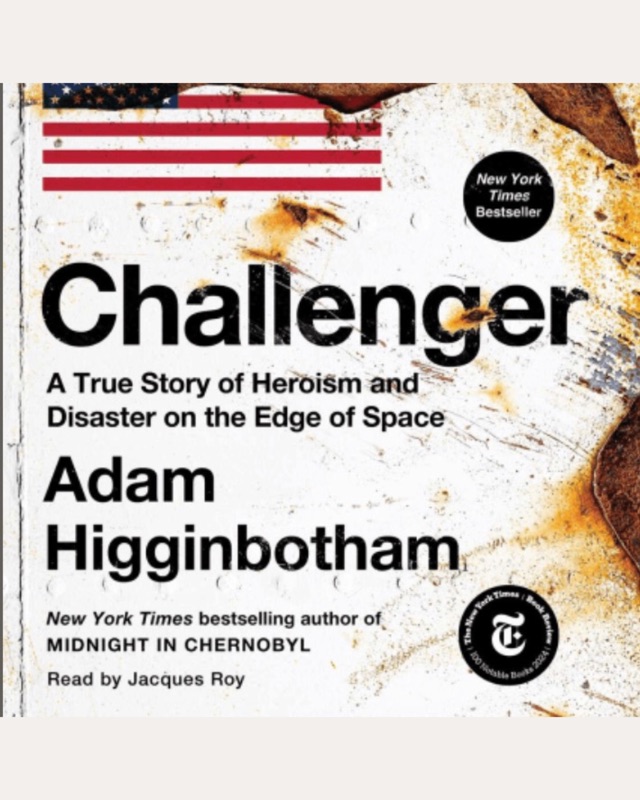
💔 Suffice it to say, this was my favorite book of 2025 and as a dedicated cozy mystery reader, that this nonfiction claimed my top spot, is saying something. It is simply phenomenal and I urge everyone to grab a copy or add it to your library holds asap! I am a passionate CTSHDES evangelist and I will not stop singing this book’s praises. If you ask me if I’ve read anything good lately, buckle up, because I’m about to unleash the following on you.
💔 Although I’m not a scientist, I have a layperson’s fascination with space and those brave enough to test the limits of human capability. Although I was young, I’ll never forget the Challenger tragedy. I was in pre-k in Jacksonville, Florida at the time. On shuttle launch days it wasn’t uncommon for us to go outside to see the white streak of the shuttle in the sky as it cruised over the Atlantic ocean. That day, I have a distinct memory of being outside and excitedly staring up at a clear, blue sky eager to see the “first teacher in space” until suddenly something went awry and our teachers quickly shepherded us back into our classroom. It’s one of those horrible, national tragedies that forms a core memory. In this book, Higginbotham painstakingly tells us how it came to be in such detail, that I feel he does justice not only to the lives lost onboard Challenger, but also to those engineers and scientists on terra firma who fought hard to prevent it. Their stories deserve to be told.
💔 The news and subsequent hearings focused on costly time delays, design issues (flammability, weight), external time deadlines (space race), the reliance on subcontractors and lowest bidders, and the constant PR dance for all missions that was vital to maintain taxpayer interest. Higginbotham covers all that like an investigative journalist, but also delves into the lives of each ill-fated astronaut, and the history of the manned program going back to Apollo I to provide a fuller portrayal of the true cost of these missions. He humanizes the superhuman astronauts and their terrestrial scientific and engineering counterparts.
💔 Higginbotham’s writing style is evocative and laden with thoroughly researched historical and technical detail. I had to keep reminding myself that this was a nonfiction account, particularly when he unpacked the frantic back-and-forth between Thiokol engineers, the Marshall Space Center, and Kennedy Space Center teams in the 24 hours prior to the ill-fated launch. Friends, I cannot recommend this book enough. You will learn so much.
NB what follows are my stream of consciousness thoughts as I listened to this audiobook. I did my best to group them into semi-coherent form, but by the end of it, you’ll see (if you last that long) I ran out of steam and ended abruptly. Sorry to all my English teachers, there’s no conclusion. The conclusion you may infer if you make it that far is that you should definitely read this book.
💔 CTSHDES begins at the instant of the fateful Challenger launch and immediately jumps back to the lead up to Apollo I. “Go fever” swept the nation as it would in 1986. The race to the moon had begun, and with it, the first tragedy that claimed the lives of 3 astronauts. The first person on the scene of the Apollo I tragedy said of the harrowing final moments of the 3 trapped on board: “I cannot describe what I see”. Higginbotham foreshadows the NASA public broadcaster in 1986 similarly struggling to form words to describe what everyone witnessed in the sky.
COLUMBIA ——*——CHALLENGER——*——DISCOVERY
💔 TFNG = the fucking new guys. Astronaut class 8. AH goes into detail about how the eventual ill-fated Challenger astronauts came to be astronauts in the first place. They were among the 30 chosen as part of this class. We get to learn about each of them individually.
💔 Side note: the development of the revolutionary reusable winged space craft (space shuttle) design is covered in great detail at KSC if you ever have a chance to visit. It’s fascinating! We get some early foreshadowing in CTSHDES about the space shuttle design that we obviously do not get at KSC. NASA cuts a deal with the Air Force to get support. As a result, the shuttle is forced to carry a heavier payload than Faget envisioned in his early designs. An astronaut emergency escape/eject is dropped from the final design to accommodate the heavier payload. When do you suppose that might have been providential?
💔 I didn’t realize the grueling mission schedule for Columbia, Challenger, and Discovery. AH provides detailed explanations of the flaws and their effects as well as the bureaucracy every step of the design/refurbishment process across numerous facilities.
Test data as far back as 1977 identified the potentially catastrophic design flaw in the rocket booster’s o-rings, and it was disregarded by both NASA and Thiokol (the manufacturer of the rocket booster). Additionally, data about dangers of cold weather launches had been provided to NASA managers by engineers, but this too had been disregarded. These 2 technical concerns come together in the most dangerous way imaginable with the ill-fated Challenger launch. Based on the frequent mission schedule, this disaster was a ticking bomb waiting to happen to one of the shuttles in the fleet. If not to Challenger, then to Columbia or Discovery.
💔Columbia — “the boosters had never been flight tested” and AH notes that the “acoustic pulse generated by engine ignition was miscalculated by magnitude of 10”. Now, I’m no scientist but that sure seems like a massive miscalculation doesn’t it? Yikes already. This is also the first point we hear about the “zipper effect” in connection with the shuttle design.
💔 Challenger — remember, the leaky o rings on rocket boosters were identified as concern as early as 1977 but it became a question of “how much risk they could tolerate” based on fairly spurious risk figures. NASA continues to send the shuttles up with the solid rocket boosters using these o-rings that have the known design flaw.
Prior to launch day, AH breaks it down to 24 hours of hour-by-hour detail which heightens our tension as readers to a critical point. We know what’s coming and it’s unbearable. Time is spent between NASA executives, Thiokol engineers, the astronauts themselves and their families, and mission control. AH writes vivid descriptions with both mundane, human details and scientific details.
Record below freezing temperatures at Cape Canaveral, set off warning bells for engineers at Thiocol in Utah. AH noted previously that Beaujolais’ findings months ago about the impact of cold weather on the efficacy of the O-rings had been buried among mountains of other concerns.
The night before the launch, Thiokol engineers Beaujolais and MacDonald (know these names because these men are brave as hell) are vehement that the launch should be scrubbed. Thiokol rocket booster engineers unanimously recommend “do not launch”.
It was unprecedented for the rocket booster subcontractor to call NASA to abort the launch.
Having scrubbed prior launches due to other circumstances, NASA is reluctant to abort yet another launch. The group at Marshall in Huntsville and KSC in Cape Canaveral disagree. Eventually, Thiokol executives feel pressured to withdraw their objection and are bullied into agreeing to launch. They, in turn, pressure their own engineers (Beaujolais and MacDonald) who stand firm. Thiokol executives eventually overrule their engineers and make a “management decision”.
NASA takes an unusual step of demanding a signed GO from Thiokol; for the prior 24 missions a verbal GO was ok. Why the sudden change? It’s a suspicious deviation from norms. Additionally MSC and KSC don’t inform Johnson Space Center of the Thiokol objection.
The morning of the launch, a Rockwell executive (subcontractor for Orbital) at KSC witnesses frozen conditions of the launchpad and also makes a NO GO. NASA disregards. The tally is now 2 subcontractors voicing NO GOs for launch. NASA disregards both. I’m hearing this and fully freaking out, because AH contrasts these literal life-and-death decisions with the quarantined crew going about mundane activities such as chatting with family members and walking along the beach.
💔 Aftermath of the tragedy
The selflessness and courage of June Scobie (wife of the mission commander) and Jane Smith (wife of the pilot) in communicating their unwavering support of the NASA mission on behalf of the group when they met with VP George Bush on the day of the tragedy, is notable. I can’t imagine how they managed in these circumstances.
Reagan, in his speech that day (written by Peggy Noonan) includes a quote from “High Flight”. It felt like a “national bereavement” as AH writes, well and truly. Even as kids, we felt it.
Beaujolais knew as soon as he saw puffs of black smoke from the rocket booster in tv footage, what had happened. There was no question in his mind.
NASA obfuscation during the Rogers Commission hearing was deplorable. At this point, you’ll feel there’s some “Pelican Brief” level skulduggery going on. I was seeing red. Human error happens. The astronauts themselves accept this risk. But the deceitfulness and lack of accountability? Nobody signed up for that.
NASA was caught out by the press for not disclosing the meeting with Thiokol the night before launch, but was forced to admit it during the hearing. MacDonald acted courageously when he interrupted the closed door hearing in which NASA executives failed to mention Thiokol’s initial NO GO at that meeting. MacDonald forced NASA and Thiokol executives to respond to questions as to why they went against Thiokol engineers’ recommendations.
If not for his interruption, the NASA and Thiokol execs would have avoided the damning evidence of their willful disregard of the dire warning from the Thiokol engineers, and any public accountability that would follow.
Later in the hearing, I loved Fineman’s cut the crap approach with his live o-ring experiment. He sets out to uncover the deeper “management rot” at Marshall. The acclaimed physicist was a worthy stalwart who knowingly gave the final months of his life to uncovering the truth. His scathing criticism of NASA can be found in Appendix F. His term “magical thinking” was prescient as it haunts NASA in the 2003 Columbia disaster as the same “institutional hubris” strikes again.
You really can’t make up more villainy than what is shown in the records of the Rogers Commission. The duplicitousness of Marshall, KSC, and Thiokol execs (Malloy at KSC and Mason at Thiokol in particular) made me seethe while simultaneously underscoring the courage of MacDonald and Beaujolais, at great personal cost.
I felt that the Rogers Commission was an example of an investigation done honorably and diligently. When it became clear that NASA was obfuscating, Rogers decided to by-pass their information and conduct the interviews themselves.
On par with the drama in the hearings in DC and the Cape was the undersea recovery drama off the Space Coast in Florida as crews found the crew compartment, and remains of all onboard (despite NASA insistence that they vaporized in a flame ball in the sky), crew personal effects, and evidence of what went wrong - including a 1.5 minute internal crew intercom recorded but not relayed with mission control. Pause here for a moment. Everyone I preach the gospel of this must-read to, has been as stunned as I was by this revelation. I know I was a child, but all my life I’ve believed that the crew died instantly when the conflagration occurred in the sky. To learn that this is not true, shakes my understanding of the tragedy to its core. That they could have been alive for 2 minutes or so longer beyond that point, and conscious of their fate, amplifies the horror.
The crew remains (some still strapped in chairs) suggests they may have astonishingly survived the booster rocket conflagaration, but died from the violent impact with the Atlantic ocean. Recall that a crew ejection apparatus was deemed unnecessary in the early design stage of the space shuttle. Additionally, there was evidence that the highly capable pilot Smith (“nobody’s fool”) did what he could in the final 2 minutes though he knew it was futile.
🌌 Recommended reading
“Orbital” by Samantha Harvey (fiction). This was the 2024 Booker prizer winner and is stunningly written. I highly recommend!


Comments
Post a Comment