Review: “The Golden Gate” by Amy Chua

🌉 TGG is a fantastic dual timeline/dual murder mystery with the added bonus of providing thoroughly researched historical background of the Bay area in the ‘30s and ‘40s as a backdrop. I highly recommend this one for historical fiction and mystery lovers alike!
🌉 I didn’t know Madam Chiang Kai-Shek resided in Berkeley during WWII while the US tried to decide whether to back her husband General Chiang, to gain China’s support, rather than his adversary, the communist Mao. She was the first woman to address Congress.

🌉 Half-Mexican Al Sullivan (formerly Alejo Gutiérrez) grapples with his identity as he is working his way up the SF police force and trying to make a better life for himself. Things are on the straight and narrow until he is tasked with enforcing FDR’s internment exec order (we’re all too familiar with government sanctioned racial profiling these days).
🌉 Korematsu (and onward): the constitutionality of racial profiling then and now.
In Korematsu v. United States (1944), SCOTUS upheld the internment of Japanese-Americans during WWII, ruling that military necessity could justify racial exclusion orders. The case is historically significant because, while never formally overruled until Trump v. Hawaii (2018) effectively repudiated it, Korematsu established the “strict scrutiny” standard for racial classifications — meaning race-based government actions must serve a compelling interest and be narrowly tailored — a test that now ironically serves as the primary tool to strike down racial discrimination.
Fast forward to Noem v. Vasquez Perdomo in today’s dystopian constitutional climate, and things go awry. In a 6-3 vote, SCOTUS granted the current administration’s emergency request to stay a district court’s order that had found DHS officials relying on factors such as ethnicity alone when detaining someone to be “insufficient and impermissible”. The Court’s majority offered no legal explanation for its decision, drawing a blistering dissent from Justice Sotomayor, who called it “unconscionably irreconcilable with our nation’s constitutional guarantees.”
Importantly, this order is not a final ruling, but it strongly signals SCOTUS will not uphold strict constitutional limits on immigration agents’ authority to stop and question people they suspect to be immigrants.
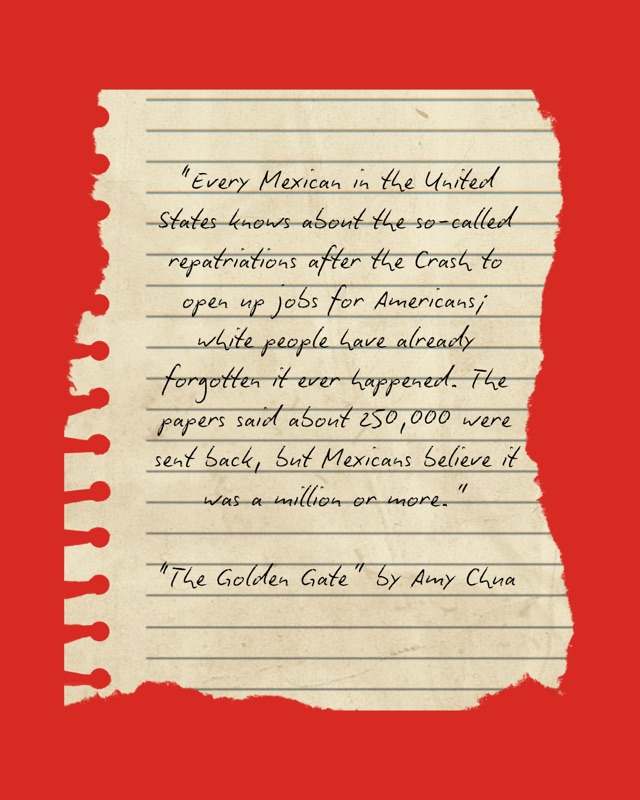
🌉 After the stock market crash of 1929 and the onset of the Great Depression, widespread unemployment and economic hardship led to growing anti-immigrant sentiment. Mexican and Mexican American communities were targeted for mass deportation and “voluntary” repatriation, under the claim that removing them would free up jobs for white Americans.
I am truly grateful to Chua for elaborating on this forgotten injustice of the 1930s; indeed it is a critical part of U.S. immigration and civil rights history that is particularly relevant now, but has been left out of most history textbooks.
🌉 Mexican Repatriation
If someone out there is an expert researcher or happens to know more about this subject, I’d be grateful to learn more. From what I could see, there is extremely limited information available online.
The Mexican Repatriation of the 1930s was not the result of a single formal federal policy, but rather a decentralized effort involving local, state, and federal authorities. However, various government agencies and officials were directly complicit in the mass deportations and coercive repatriations.
At the federal level, the government supported efforts to remove undocumented and even legal Mexican residents to reduce job competition. New Deal agencies (e.g. Works Progress Administration and relief programs) excluded non-citizens, which intensified pressure on Mexican communities to leave. These actions were often unconstitutional, carried out without due process, and many families were separated or uprooted.
It was at the California state and local government that most aggressive action was taken.
• Organized “repatriation drives”
• Used threats of deportation, loss of welfare, or employment to pressure people into leaving
• In some cases, trains and buses were chartered to send people to Mexico
Timeframe: Mainly 1929–1936
• Key actors: U.S. Department of Labor (INS), state and local governments
• Methods: Raids, threats, denial of aid, public pressure campaigns
• Legality: Often bypassed constitutional rights; few had legal recourse
• Estimated affected: official records claim 250,000, historians and community sources estimate the number may have been closer to 1-2 million, including many U.S.-born citizens of Mexican descent.
As I said earlier, I was shocked that not many resources about the Mexican Repatriation are readily available online. I’m less surprised after searching that I never even knew it happened.
Sources:
https://www.history.com/articles/great-depression-repatriation-drives-mexico-deportation
If you can find it, this appears to be a seminal work on the subject:
“Decade of Betrayal: Mexican Repatriation in the 1930s”
Authors: Francisco E. Balderrama and Raymond Rodríguez
Publisher: University of New Mexico Press
First published: 1995 (revised edition in 2006)


Comments
Post a Comment