Review: “Pale Blue Dot” by Carl Sagan
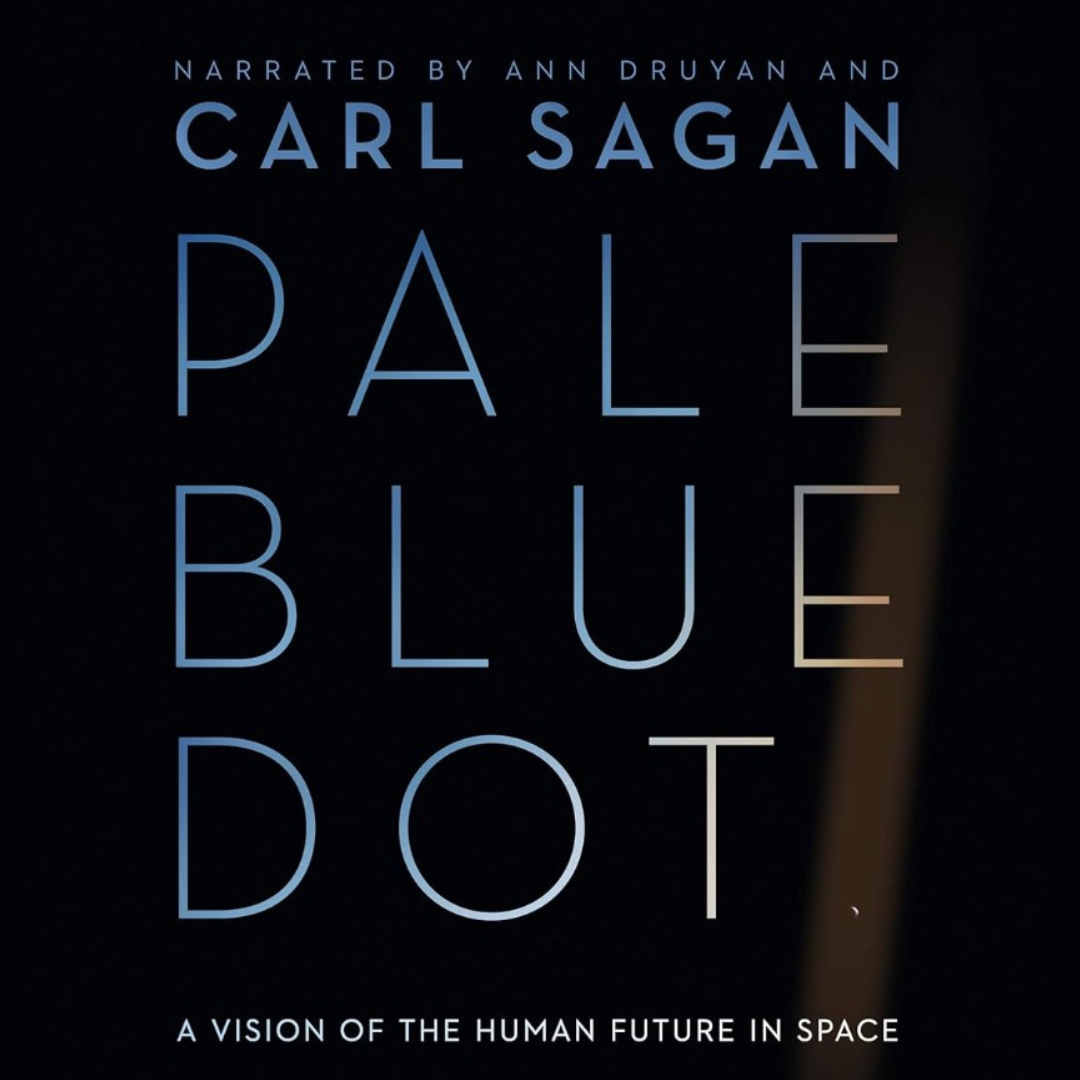
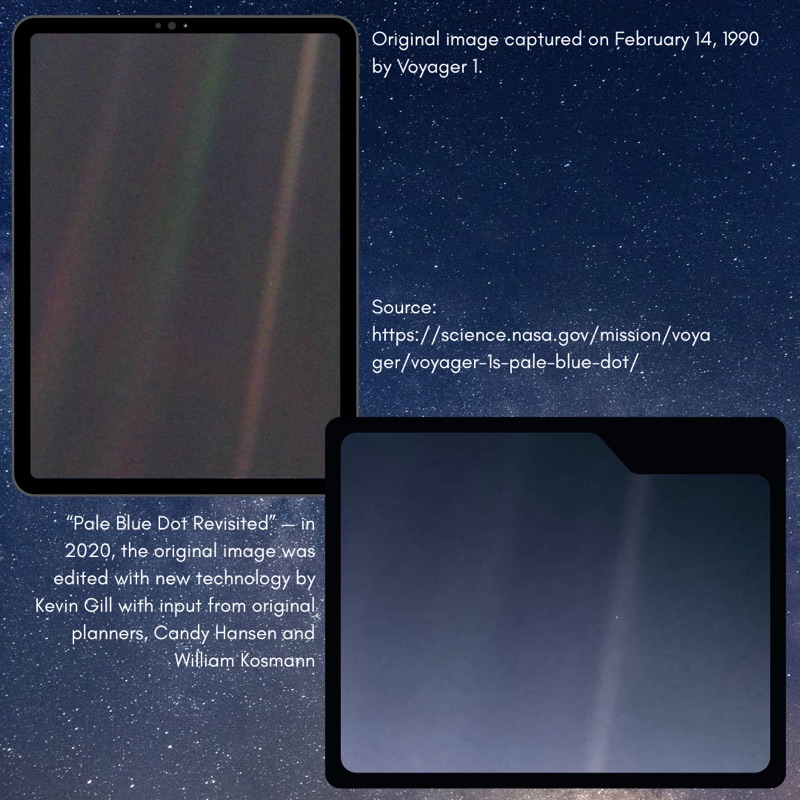
🌌 Last Saturday was the 32nd anniversary of Carl Sagan’s request of NASA to turn Voyager 1’s camera to capture a now famous photograph of Earth from a distance of about 3.7 billion miles. There it is on the cover of this book. Because it bears repeating, a human-made machine took this photograph of Earth from 3.7 billion miles away.
While Sagan would give us insightful thoughts on viewing our planet from such great distance, he also takes time to marvel at the spacecraft, and the scientists and engineers responsible for the Voyagers. He said the Voyagers themselves will “speak eloquently for us” more so than any time capsule to be found by roving space travelers from other galaxies. Per Sagan, the Voyagers are a testament to the ingenuity of humankind. And if you pause just to consider that people on Earth are able to control a device, manipulating data traveling at the speed of light from almost 4 billion miles away, it’s mindblowing. When he comments that these men and women should be on stamps, and wildly celebrated, I have to agree! Why don’t we know their names?! They should be household names certainly.
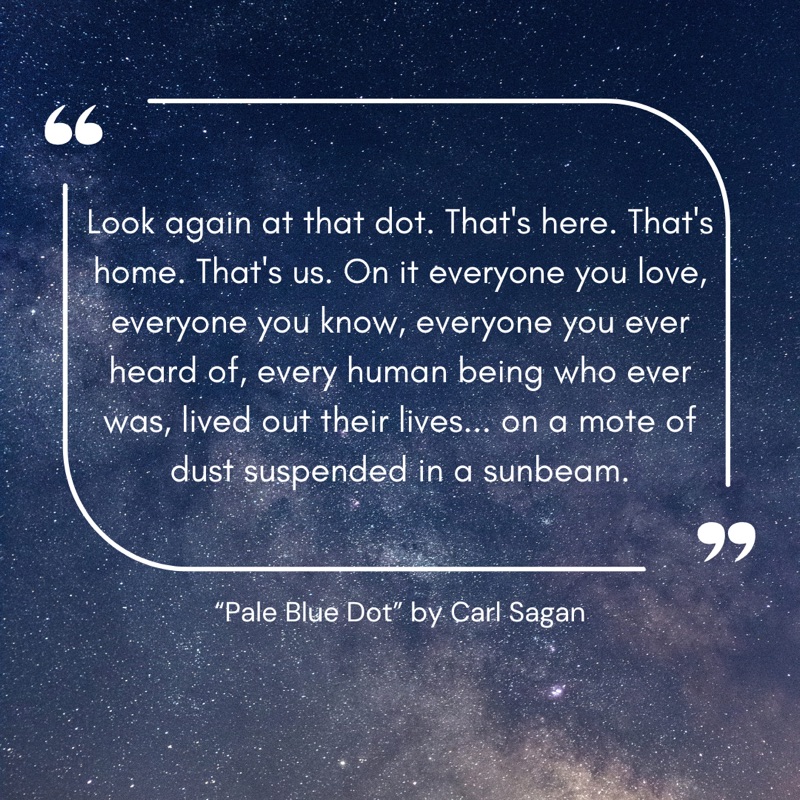
🌌 The most famous passage from PBD is this soliloquy which I’m quoting in part here. Ever philosophical, Sagan gives us much to ponder, but I walked away with 2 main points: the necessity for humankind to approach our existence with proper humility, and our duty of stewardship that necessarily arises as a result of that humility.
Humility
Our place in the cosmic scheme is obviously insignificant - we are but a speck of dust! All our conflicts, wars, and battles are utterly absurd in this light. Our so-called sweeping history all existed on this tiny dot. Yet since it’s all we’ve known we have a human-centric ego. Sagan wanted to capture this image to help us refocus our egos and develop a proper sense of our insignificance in the cosmos. In this grand scheme, we truly don’t matter any more than any other species.
Stewardship
Sagan challenges us to protect our tiny insignificant speck by shattering the conceit of human self-importance. If not us, than who in this empty vastness will come to our rescue? The answer is so apparently no one. The duty is upon us, having gazed upon the emptiness, and realizing that we are the only ones capable both of destruction and preservation, that we must now act.
🌌 The gift of Apollo
The Apollo missions were extremely well funded. When JFK made his rousing speech - the alloy technology that would get us to the moon wasn’t created or even known. The money didn’t flow for science, it flowed for politics. JFK pushed for a man on the moon by 1969 and space became a political battleground in the minds of civilians (US vs Soviets). Since then, the money dried up there hasn’t been a manned mission to the moon (NB — it looks like NASA is restarting manned missions, so stay tuned in 2026?).
But the gift of the Apollo space race and funding was undeniable: good science. Mariner, Viking, Voyager spacecrafts are descendants of Apollo’s science.
However by 1994 (when PBD was published) space exploration was stagnating. Based on the Apollo zeal, Sagan writes that he would have expected manned missions on Mars by 2000. But soon after the final Apollo mission, it was clear that this was not to be. Any Mars missions would be via robotic spacecraft.
🌌 Spacefaring and terraforming
Sagan was firmly of the belief that space exploration must be resumed to study habitability elsewhere. He states emphatically that it is not a matter of if but when. He presents alarming data on human on-going destructiveness as well as probabilities of other catastrophies, and states quite calmly (it’s terrifying, I’m not going to lie), that life on Earth will eventually face extinction unless alternatives are established. Per Sagan, humans have no choice but to become spacefaring.
Sagan provides a cogent explanation for why he believes Mars is the most deserving of our close attention - surprisingly (to me anyway), his reasons are quite practical. He goes on to state that if not for studying human habitability, we must ask why we continue to send astronauts to the ISS. What exactly is the purpose of studying the effects of zero gravity on blood/bones? I definitely had never thought of it in such practical terms.
Here, he also talks about terraforming - making other planets habitable for humans. Sagan goes into questions of why, how, and ethical dilemmas.
🌌 Asteroids and comets
As far as ethical dilemmas, he tells the parable of the Marsh of Camarina wherein a town drains a marsh and so ends a plague, but in so doing eliminates a natural defense and paves the way for greater horror as enemies attack. He illustrates the dilemma of trading one danger for another - specifically, he is talking about diverting asteroids/comets. Eventually in millions of years, a major impact will occur. Technology to alter orbit does exist, however if you change the orbit of `, it will change the orbit of others, and could send those into Earth’s path while diverting the 1.
The bit about such tech in the hands of megalomaniac leaders is prescient for our current times and hits alarmingly close to home. As if all of the asteroid, comets, and extinction talk wasn’t enough. Ooof.
🌌 SETI
SETI is listening for signs of intelligent life. Signs of biological, cultural, linguistics markers will be vastly different from other beings, but Sagan says science will be science. Therefore radio is the language of choice for potential communications. Whether potential communications would be decipherable, that is another story altogether. Sagan dips into the poetic while describing scientists “interrogating the darkness”.
🌌 I learned a great deal from this book. “Cosmos” is next on my list though it was published in 1980 while PBD was published in 1994. But I believe it also speaks to the theme of human exploration in the universe.
🌌 Recommended reading
“A Short History of Nearly Everything” by Bill Bryson
“Challenger” by Adam Higginbotham
“Orbital” by Samantha Harvey (fiction)


Comments
Post a Comment